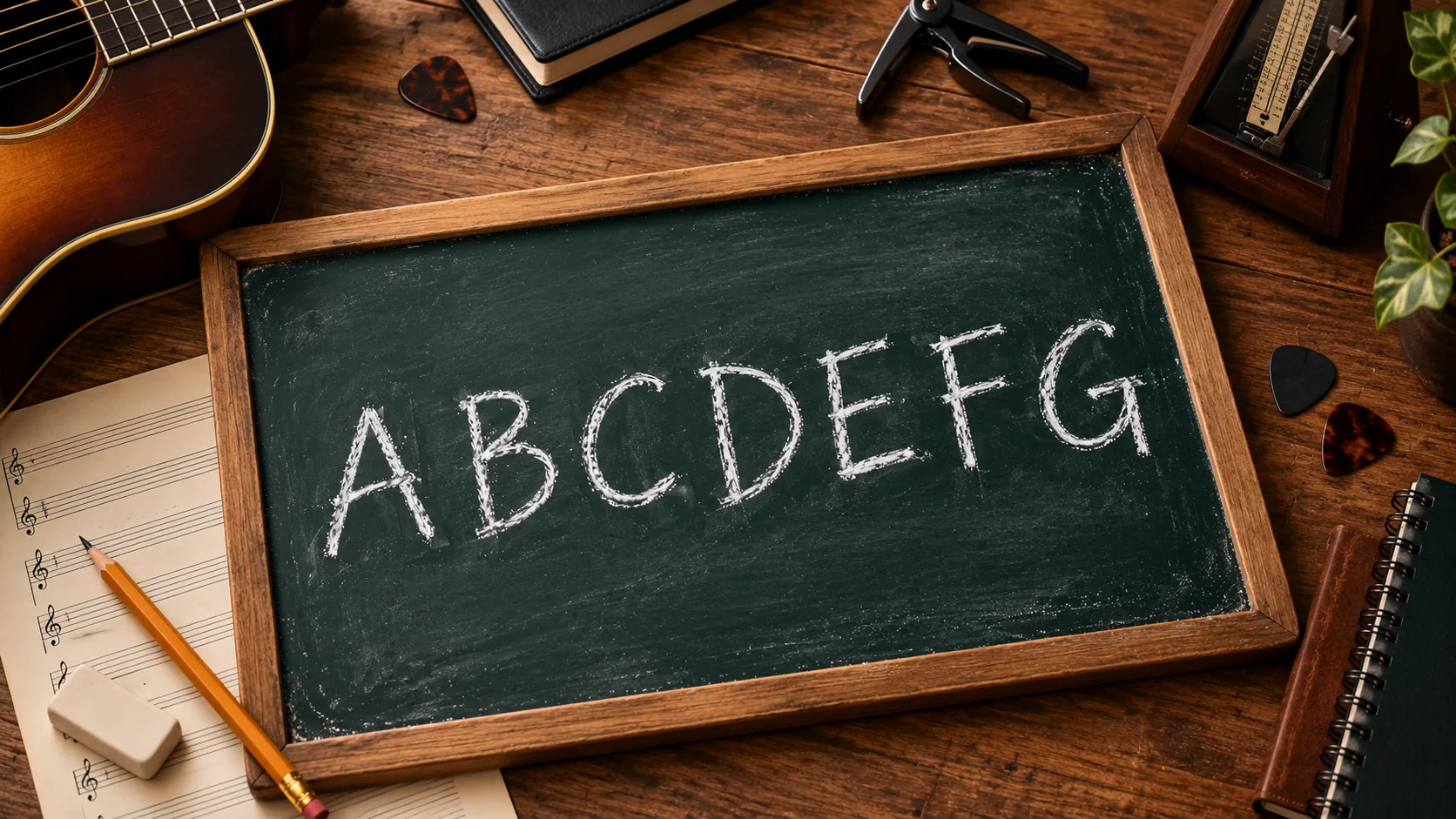
The musical alphabet is the system used to name notes in Western music. It consists of seven letters, A through G, which form the foundation for understanding scales, chords, intervals and how notes relate to one another.
The Seven Natural Notes
Unlike the English alphabet, which contains 26 letters, the musical alphabet uses just seven:
ABCDEFG
These are known as the natural notes.
After G, the sequence begins again from A, repeating at higher or lower pitches.
ABCDEFGABC…
This seven-letter system is the basis of how notes are named in Western music. However, the distance between neighbouring natural notes is not always the same, and there are additional pitches between most of them.
To understand how these fit together, we first need to look at the octave.
The Octave and the 12-Note System
An octave is the distance between one note and the next higher or lower note with the same name.
Most modern guitars, pianos and other fixed-pitch Western instruments use a tuning system called 12-tone equal temperament, which divides an octave into 12 equal steps.
Each step is called a semitone, also known as a half step.
In this system:
An octave contains 12 semitones.
Each semitone represents the smallest pitch movement between adjacent frets on a conventional guitar.
After 12 semitones, the note sequence repeats in the next octave.
Although the musical alphabet contains seven natural note names, there are 12 distinct pitch classes in this system.
Seven of these positions are represented by natural notes. The other five positions lie between neighbouring natural notes and are commonly named using sharps or flats.
Visualising the 12 Notes
The following sequence shows the 12 pitch positions within an octave, starting from A:
AA♯/B♭BCC♯/D♭DD♯/E♭EFF♯/G♭GG♯/A♭
Moving from one position to the next raises the pitch by one semitone.
The next A begins the same sequence again, one octave higher than the first.
There are three important things to recognise:
The musical alphabet uses seven natural note names: A, B, C, D, E, F and G.
The chromatic system contains 12 pitch classes, including five positions between the natural notes.
Some pitches can be represented by more than one note name.
The relationship between these notes is important because it determines how scales, chords and intervals are constructed.
Sharps and Flats
♯♭
Sharps and flats are symbols used to alter the pitch represented by a note name.
A sharp (♯) raises a note by one semitone.
For example:
A raised by one semitone becomes A♯.
C raised by one semitone becomes C♯.
A flat (♭) lowers a note by one semitone.
For example:
B lowered by one semitone becomes B♭.
E lowered by one semitone becomes E♭.
This means the pitch between A and B can be called either A♯ or B♭.
Both names represent the same pitch on a conventionally tuned modern guitar, but the correct name depends on the musical context.
Enharmonic Equivalents
Notes that share the same pitch but have different names are called enharmonic equivalents.
Common examples include:
A♯ and B♭
C♯ and D♭
D♯ and E♭
F♯ and G♭
G♯ and A♭
On a guitar using equal temperament, each pair is played at the same fret and produces the same pitch.
However, the distinction between the names is still important.
For example, the F major scale contains the following notes:
FGAB♭CDE
We use B♭ rather than A♯ because a correctly spelled major scale uses each of the seven letters exactly once.
Writing A♯ instead would give the scale two different A notes and no B note.
You don't need to memorise every rule for spelling scales at this stage. For now, it's enough to understand that the same pitch can have different names depending on how it functions within a scale, chord or key.
The Natural Half Steps
Most neighbouring natural notes are separated by two semitones, which is called a whole tone or whole step.
There are two important exceptions:
BC
1 semitone
EF
1 semitone
These pairs are separated by only one semitone.
This means there is no additional chromatic pitch position between B and C, or between E and F, within the 12-note system.
You can see this relationship on a piano, where there are no black keys between these pairs. On a guitar, B and C are found on adjacent frets of the same string, as are E and F.
Remembering these two natural half steps will make it much easier to understand scales, intervals and chord construction later.
The Musical Alphabet on Guitar
The guitar provides a practical way to see how the musical alphabet and the 12-note system work together.
On a conventionally fretted guitar, moving up one fret raises the pitch by one semitone.
As you move along a string, you pass through the chromatic sequence until reaching the same note name one octave higher.
For example, the open sixth string is tuned to E.
Moving along that string gives us:
EFF♯GG♯AA♯BCC♯DD♯E
At the 12th fret, we reach another E, one octave above the open string.
The same principle applies to every string:
Each fret raises the pitch by one semitone.
Moving up 12 frets raises a note by one octave.
Notes repeat in the same sequence above the 12th fret.
This repeating pattern is one of the most useful reference points for learning the guitar fretboard.
Once you understand the sequence, you can begin identifying notes anywhere along a string rather than relying entirely on memorised fretboard patterns.
Why the Musical Alphabet Matters
Understanding the musical alphabet gives you the foundation needed to make sense of more advanced musical concepts.
It allows you to:
Identify and name notes on the guitar fretboard.
Understand the distances between notes.
Recognise how scales are constructed.
Understand how notes combine to form chords.
Make sense of sharps, flats and different note spellings.
Recognise how musical ideas repeat across different octaves.
You don't need to memorise every detail immediately. The important starting point is to understand the seven natural note names, how they fit into the 12-note chromatic system, and how that sequence repeats on the guitar.
Quick Self-Test
Before moving on, check that you can answer the following questions.
Once you're comfortable with the musical alphabet, continue to Finding Notes on the Fretboard to begin applying these ideas across the guitar.
For a deeper understanding of why particular scales and keys use certain sharps or flats, see Keys and Key Signatures.