Chords: Introduction to Triads
Now that you understand how intervals are named and measured, you can begin using them to build chords.
Chords are not random shapes on the guitar. They are created by combining notes at specific interval distances from a root note. The intervals included determine the chord's structure, sound and name.
In this lesson, you will learn how major, minor, diminished and augmented triads are constructed before looking at suspended chords, where the third is replaced by another interval.
Understanding these formulas allows you to build chords from any root note rather than relying only on memorised guitar shapes.
What Is a Triad?
A triad is the basic three-note chord structure used in tertian harmony. It contains three distinct notes:
Root–3rd–5th
The root gives the chord its letter name. The quality of the third and fifth determines the type of triad.
For example, a C major triad contains:
C – E – G
C is the root, E is the third and G is the fifth.
On guitar, the same triad can appear in different positions and inversions. A voicing may also double one or more notes while still containing only three distinct chord tones.
Triads form the foundation of many of the chords used throughout Western music.
Tertian Harmony
Major, minor, diminished and augmented triads are built using a system called tertian harmony.
Tertian harmony means building chords by stacking thirds. Starting from the root, we move to the note a third above it. From there, we move up by another third.
C
d
E
f
G
1
2
3
4
5
1 to 3 = a third
3 to 5 = a third
This produces the three-note structure C – E – G.
The interval formula can be applied from any root, but the resulting notes must still be spelled according to their function within the chord.
The four main tertian triad types stack thirds in these ways:
- Major: 1–3–5 — major 3rd + minor 3rd
- Minor: 1–♭3–5 — minor 3rd + major 3rd
- Diminished: 1–♭3–♭5 — minor 3rd + minor 3rd
- Augmented: 1–3–♯5 — major 3rd + major 3rd
In these formulas, 3 means a major 3rd, ♭3 a minor 3rd, 5 a perfect 5th, ♭5 a diminished 5th and ♯5 an augmented 5th.
Major and Minor Triads
Major and minor triads are the two most common triad types. Both contain a root, a third and a perfect fifth. The difference is the quality of the third.
Major Triads
A major triad uses the formula 1–3–5. It contains the root, a major 3rd and a perfect 5th.
When viewed as stacked thirds, C to E is a major 3rd and E to G is a minor 3rd. A major triad is therefore built by stacking a major 3rd followed by a minor 3rd.
Minor Triads
A minor triad uses the formula 1–♭3–5. It contains the root, a minor 3rd and a perfect 5th.
When viewed as stacked thirds, C to E♭ is a minor 3rd and E♭ to G is a major 3rd. A minor triad is therefore built by stacking a minor 3rd followed by a major 3rd.
C Major Chord
C Minor Chord
Both major and minor triads contain the same root and perfect fifth. Lowering the major third by one semitone changes the major triad into a minor triad.
Diminished and Augmented Triads
By altering the 3rd, the 5th, or both, we create different triad qualities.
Together, major, minor, diminished and augmented chords form the four main tertian triad types.
Diminished Triads
The diminished triad is built from:
1–♭3–♭5
It contains the root, a minor 3rd and a diminished 5th. Compared with C major, both the third and fifth have been lowered by one semitone. Compared with C minor, only the fifth has been lowered.
When viewed as stacked thirds, C to E♭ is a minor 3rd and E♭ to G♭ is another minor 3rd. The diminished fifth gives the chord a tense and unstable sound.
Augmented Triads
The augmented triad is built from:
1–3–♯5
It contains the root, a major 3rd and an augmented 5th. An augmented triad begins with a major triad and raises the fifth by one semitone.
When viewed as stacked thirds, C to E is a major 3rd and E to G♯ is another major 3rd. The raised fifth gives the chord an open and unresolved sound.
C Diminished Chord
C Augmented Chord
Comparing the Four Main Triads
The four main tertian triads can be compared using their interval formulas:
| Triad type | Formula | Notes from C |
|---|
| Major | 1–3–5 | C – E – G |
|---|
| Minor | 1–♭3–5 | C – E♭ – G |
|---|
| Diminished | 1–♭3–♭5 | C – E♭ – G♭ |
|---|
| Augmented | 1–3–♯5 | C – E – G♯ |
|---|
The interval formula remains the same regardless of the root note. For example, every major triad uses 1–3–5, while every minor triad uses 1–♭3–5.
Suspended Chords
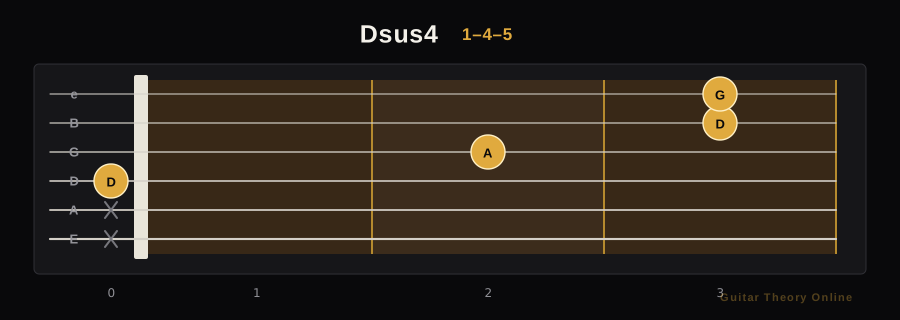
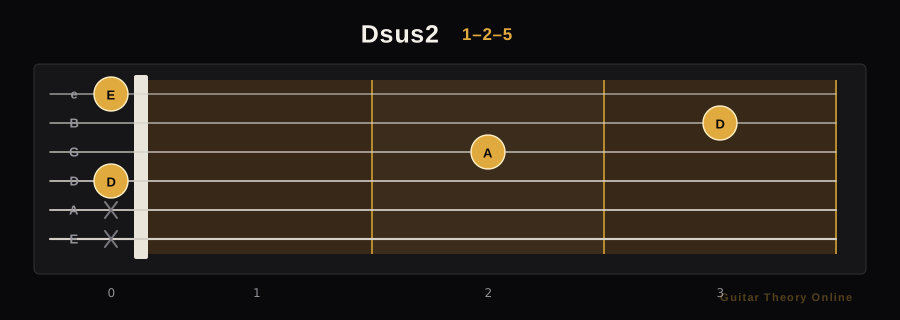
Suspended chords are three-note chords in which the 3rd is replaced by either a 2nd or a 4th. They are not conventional tertian structures because the 3rd is replaced rather than stacked above the root.
Because they contain no 3rd, suspended chords are neither major nor minor.
The word suspended is commonly shortened to sus. There are two main suspended chord types: Sus2 and Sus4.
Sus2
In a sus2 chord, the third is replaced by a major 2nd above the root.
C Sus2 Chord
Formula: 1–2–5
Compared with C major, C – E – G, the E has been replaced by D. The absence of a third gives the chord an open sound that does not clearly establish a major or minor quality.
Sus4
In a sus4 chord, the third is replaced by a perfect 4th above the root.
C Sus4 Chord
Formula: 1–4–5
Compared with C major, the E has been replaced by F. Once again, there is no third, so the chord is neither clearly major nor minor.
Suspended chords often create tension that can resolve when the 2nd or 4th moves to a 3rd, although modern music also uses them as independent chord colours.
Common Usage of Suspended Chords
The most common use of suspended chords is to create movement into a major or minor chord. A sus4 resolves when the 4th moves down to the 3rd, while a sus2 resolves when the 2nd moves up to the 3rd. The resolving 3rd determines whether the resulting chord is major or minor.
Like this:
Why These Formulas Matter
Learning chord formulas allows you to understand what a chord contains rather than only memorising a shape.
Once you know the root note and the required intervals, you can:
- Build the same chord type from any root.
- Identify the notes inside a chord.
- Alter chords deliberately.
- Find alternative chord voicings.
- Understand how different chord types are related.
- Apply chord structures across the fretboard.
In later lessons, you will build on these ideas by exploring chord inversions, extended chords and the way chords function within keys.
Quick Test
Check your understanding, then click each question to reveal the answer.
What is the interval formula for a major triad?
A major triad uses the formula 1–3–5: the root, a major 3rd and a perfect 5th.
How does a minor triad differ from a major triad?
A minor triad lowers the major triad's 3rd by one semitone. Its formula is 1–♭3–5.
Which intervals are found in a diminished triad?
A diminished triad contains a root, a minor 3rd and a diminished 5th, giving the formula 1–♭3–♭5.
Why are suspended chords neither major nor minor?
Suspended chords contain no 3rd. Because the 3rd determines whether a chord is major or minor, replacing it removes that quality.
What is the difference between a sus2 chord and a sus4 chord?
A sus2 replaces the 3rd with a major 2nd and uses 1–2–5. A sus4 replaces it with a perfect 4th and uses 1–4–5.
What notes make up a C augmented triad?
A C augmented triad contains C, E and G♯.
Use the Guitar Chord Finder and Analyser to map these chord tones and compare playable voicings, then continue to Seventh Chords to extend each triad.